

- Admitted
- September 20, 2013
- Released
- December 13, 2013
- Rescue Location
- Northumberland County, Virginia
- Cause of Admission/Condition
- Unable to fly
- Status
- Former Patient
Last Updated Jump to patient updates
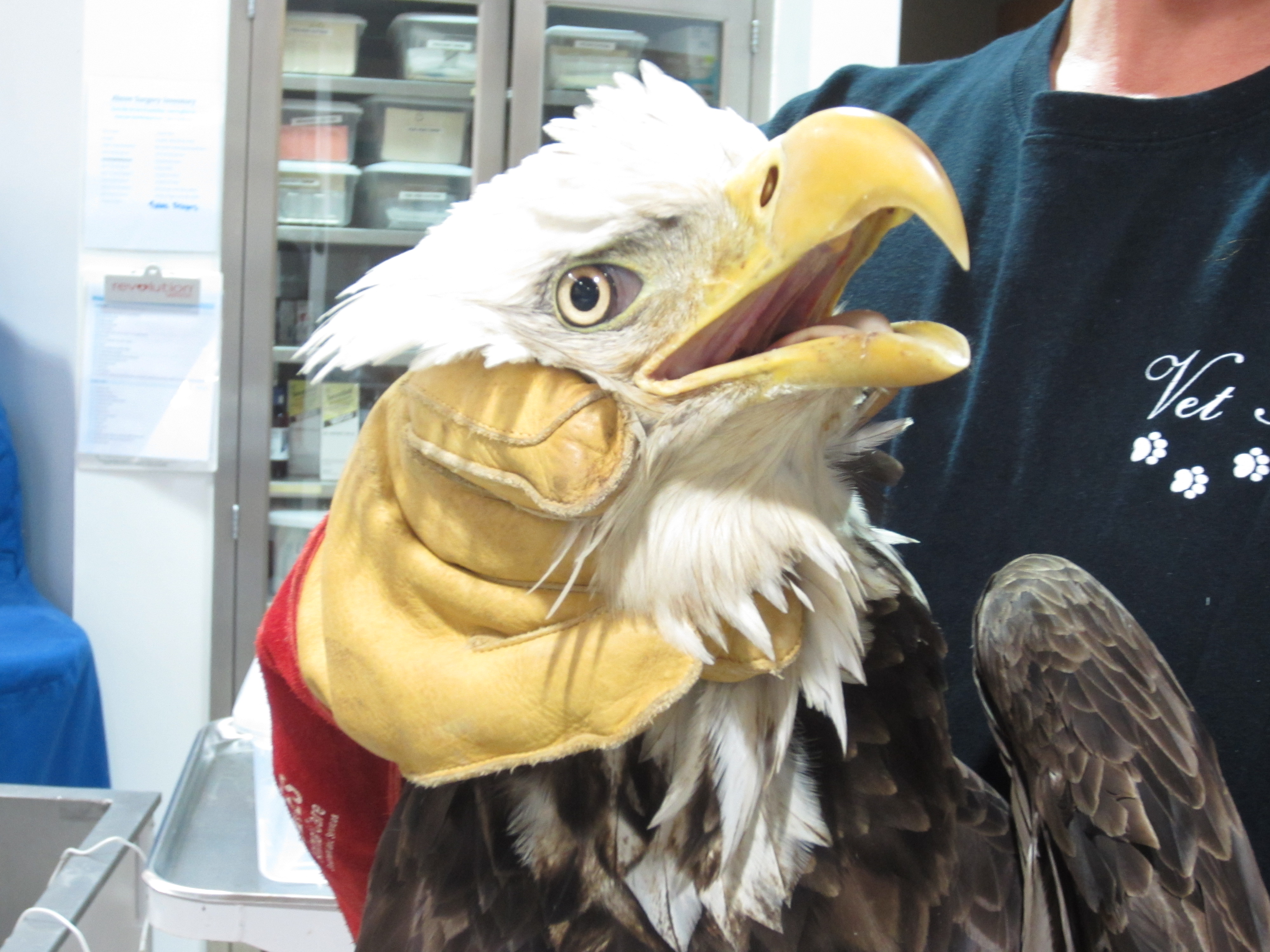
On September 19, a Bald Eagle was brought to a wildlife rehabilitator in Northumberland County. The eagle was observed unable to fly and it took several days for rescuers to successfully capture the bird. The wildlife rehabilitator who initially admitted the bird reported that the eagle was very feisty and appeared to have a wing injury.
On September 20, the eagle was admitted as patient #13-2422. The intake exam – including a physical exam, x-rays, and blood work – was performed by veterinary intern Dr. Kristin Britton, veterinary student Sara, and diagnostic intern Kelli Waller.
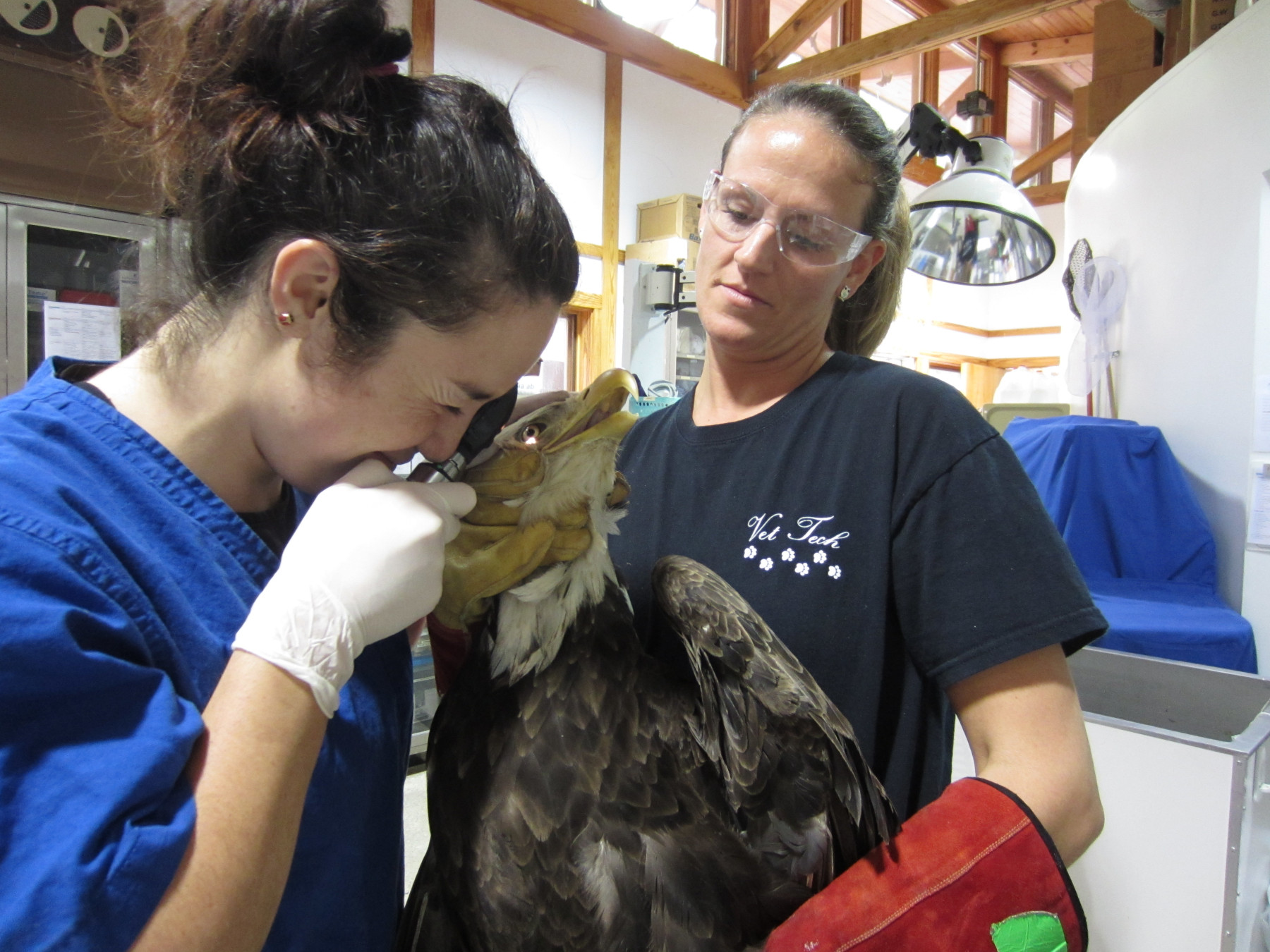
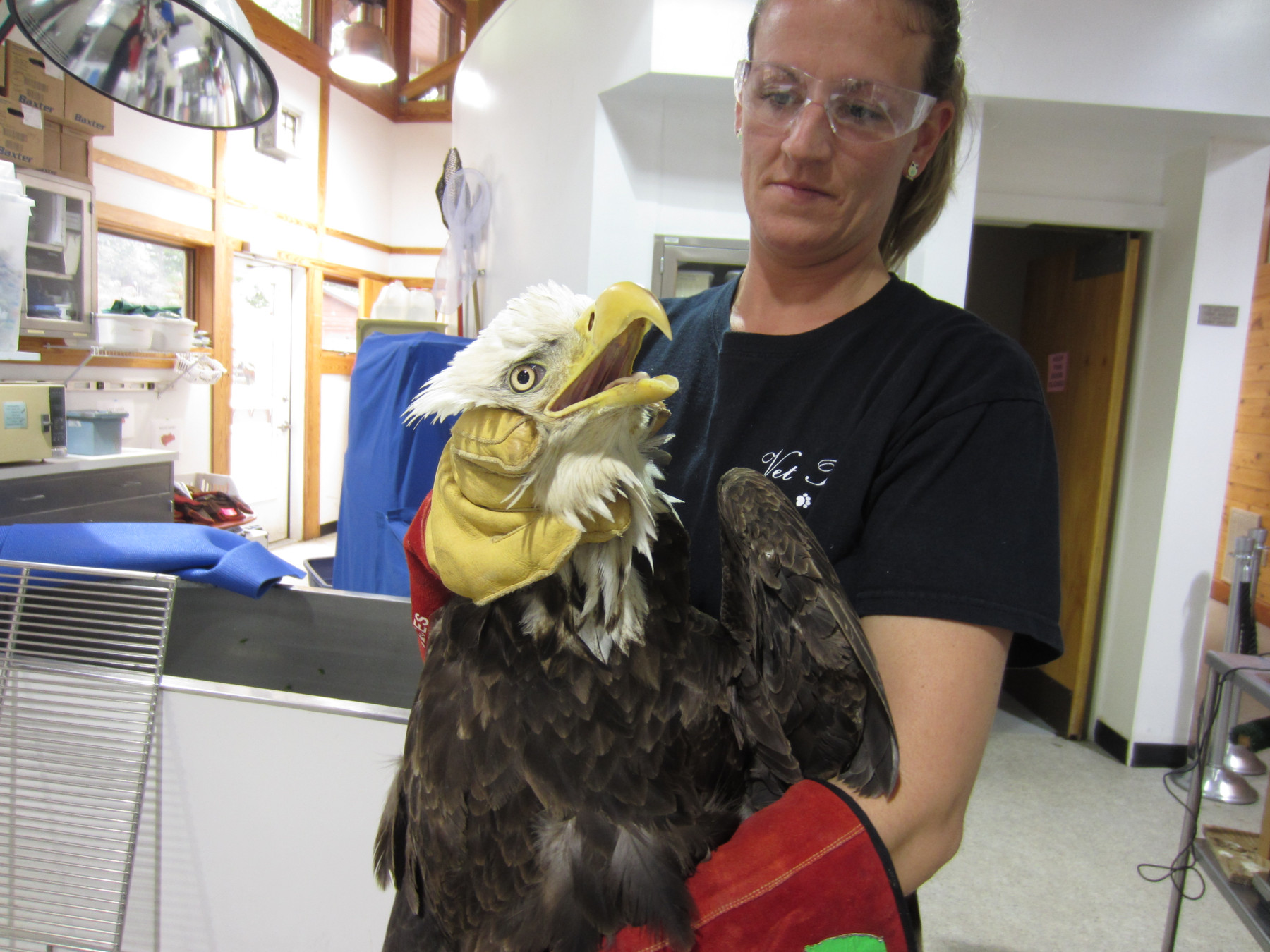
During the initial exam –which took place in the Center’s treatment area – the bird was feisty, bright, and alert. Upon admission, the eagle was in good body condition and weighed in at 4.04 kg (8.9 lbs) but was dehydrated. No abnormalities were identified during the ocular exam and bloodwork was unremarkable.
A physical exam revealed some instability in the bony structure of the right shoulder. Upon examination of the bird’s mouth, there was blood in the glottis – the entrance to the larynx and trachea. Additionally, there were increased respiratory sounds when the bird inhaled. This, combined with the suspected shoulder injury, led Dr. Kristin to believe that the eagle suffered a traumatic injury.
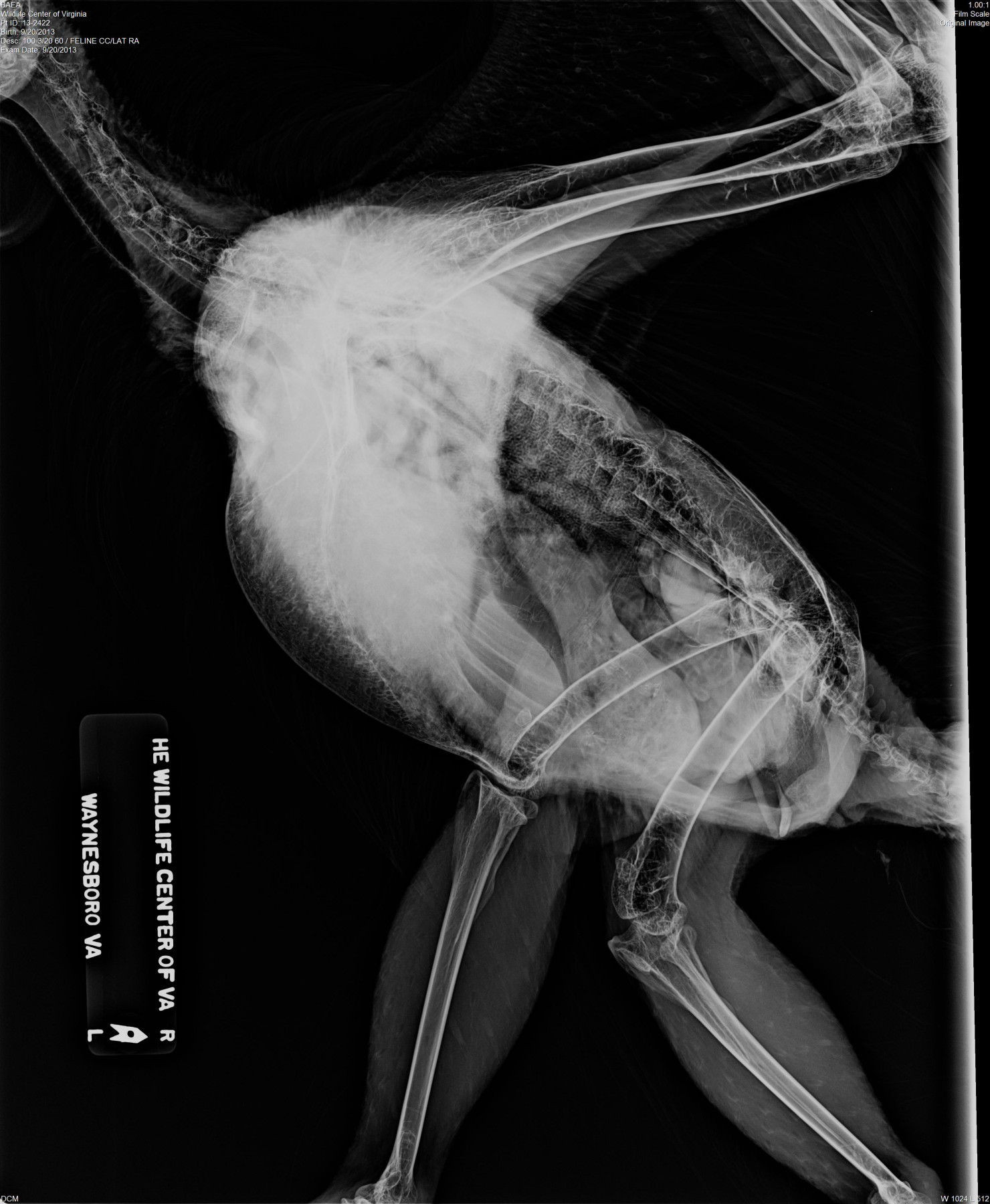
Radiographs confirmed an injury to the right coracoid [See our library of radiographs for a diagram of an avian wing]. The radiograph below show the increased opacity(whiteness) of the soft tissue surrounding the right shoulder.
A bandage was applied to the bird’s right wing to stabilize the fracture, and it will be changed every three days. A tailguard and bumpers on the left wing were also applied to prevent damage to the eagle’s tail feathers and left wing while in a confined space. Fluids were administered to increase hydration, and pain medication and an anti-inflammatory were given for pain management. Selenium was also given to assist in the recovery of muscle tissue, and A&D ointment was applied to minor abrasions on the bird’s feet.
On September 23, Dr. Kristin noted that digit four of the eagle’s left foot appeared limp Radiographs performed on September 24 revealed no soft tissue injuries; Dr. Rich believes the flaccid toe is likely due to an old injury to the flexor tendon and should not affect the bird.
As of September 24, the eagle has gained weight and remains bright alert. Beginning September 27, the veterinary staff will perform physical therapy every three days on the bird’s right wing to maintain range of motion, flexibility, blood supply and to restore the natural motion of the limb.
They will continue to monitor the patient’s hydration, attitude, and appetite, as well as monitor the bird for further respiratory distress. The tailguard, bumpers, and right-wing bandage will be monitored daily to ensure they are intact.
Patient Updates
Bald Eagle #13-2422 was released today at Belle Isle State Park. The weather was sunny and beautiful, and a crowd of about 60 people gathered to watch the release. Wildlife Center President Ed Clark did the honors; after the bird was tossed into the air, she took off across a field and perched in an evergreen tree.

Bald Eagle #13-2422 has been flight conditioning well over the past two weeks and has been flying about 12-15 passes during each daily exercise session. On Saturday, December 7, the veterinary team drew blood from the eagle for a pre-release analysis. The diagnostics were all within normal limits, and the eagle was declared ready for release.
Wildlife Center President Ed Clark will release Bald Eagle #13-2422 on Friday, December 13 at Belle lsle State Park. The 1:00 p.m. release will be open to the public; please RSVP to ksluiter@wildlifecenter.org if you are planning on attending. Attendees should meet at the Belle Island Visitor Center [1632 Belle Isle Road, Lancaster, VA 22503].
On November 13, the rehabilitation staff began exercising Bald Eagle #13-2422. Initially, the eagle had difficulty during the exercise sessions; it made only a few passes from end-to-end of the enclosure and would hop along the ground or fly to the ceiling.
By November 25, the bird was showing good stamina during exercise and was perching well. The eagle began consistently flying 8-10 passes in the flight pen. Rehabilitation intern Kelsey reported that the eagle has great maneuverability and reaches good heights when flying.
The rehabilitation staff plans to push the eagle harder during exercise. Ideally, the eagle should be able to make 10-15 passes during each session without losing height or becoming overly tired. Once the eagle reaches the optimum levels during exercise, the bird can be assessed for release.
On November 11, the veterinary staff performed radiographs on Bald Eagle #13-2422 to assess the healing progress of the coracoid fracture. A bony callus was apparent in the radiographs, and the fracture feels stable upon palpation. The fracture will continue to heal over the course of the next few weeks.
The eagle was moved to a larger flight pen [A1] to encourage use of the wing. Radiographs will be performed again in early December to further assess the fracture site.
This bird will be featured on the Center’s Critter Cam!
On October 28, the veterinary staff performed radiographs for Bald Eagle #13-2422. The bird’s coracoid fracture seems stable, and a more significant bony callous has formed. The veterinarians cleared the bird for an A-frame and higher perches in its enclosure.
In mid-November, the staff will evaluate the bird’s progress to determine if it can be moved to a larger A-pen enclosure.
Bald Eagle #13-2422 has remained well-hydrated, bright, and feisty during the past two weeks. The bird’s right wing has had great range of motion during the physical therapy sessions.
Radiographs do not show signs of callous formation at the fracture site – a callous formation would be evidence that the fracture is healing. However, upon palpating the shoulder, Dr. Rich determined that the fracture felt much more stable.
Typically, a patient would remain on cage rest to limit movement until a more definite callous was formed; however, because this eagle patient is feisty and very active in its cage, Dr. Rich felt it was appropriate to give the bird more space. On October 12, the eagle was moved from the metal cage complex to a C-pen. To minimize the eagle’s movement in the larger enclosure, the rehabilitation staff placed the perches lower to the ground.
On October 28, radiographs will be performed to assess how well the coracoid fracture has healed. At that time, the veterinary staff will determine if the bird needs continued rest or if the eagle can be given higher perches.
Almost one week after admission, Bald Eagle #13-2422 was gaining weight and was well hydrated. The veterinary staff began physical therapy on the bird’s right wing on September 28. The physical therapy is performed every three days, and the bird has good extension of the wing by the end of each session.
On September 29, the eagle was moved to the Center’s outdoor metal-cage complex. The veterinary staff will continue to monitor the bird’s attitude and appetite, and the range of motion in the bird’s right wing will be assessed during physical therapy. The body wrap remains intact to stabilize the right wing.